

The “new” Armenian community in Diyarbakir is composed of Armenians from Islamized families who have been able to reconnect with their ancestral culture thanks to the restoration and reconsecration of the Surp Giragos Church in 2011.
These “new” Armenians represent an invaluable opportunity to revive Armenian identity in Western Armenia. They can serve as a powerful bridge between the diaspora and Turkish and Kurdish societies, helping to break down stereotypes in the Turkish public sphere, promote Armenian culture, and bring greater visibility to Armenian historical experiences and memories including, indirectly, the genocide of 1915.
To make peace or wage war, it takes two
The Armenian genocide, its recognition, and reparations are Turkish issues that must be resolved in Turkey, by addressing Turks, in Turkish.
Guided by this conviction, YERKIR1, A Franco-Armenian NGO, has spent nearly eighteen years developing innovative programs in Turkey that engage with Armenian questions through cultural and intercultural initiatives. These efforts focus on Armenian identity and memory, including the legacy of the genocide, on conflict resolution and on the restoration of both the tangible and intangible Armenian heritage.
Diyarbakir, the capital of southeastern Turkey
YERKIR established ties with the pro‑Kurdish municipality of Diyarbakir (1.7 million inhabitants, the vast majority Kurdish) as early as February 2008, leading to collaborations that continue to this day. In partnership with the city council, we have organized concerts, artist and musician residencies, and genocide commemorations, all in cooperation with the municipality.
By expanding our activities in Turkey and across Anatolia, we have been able to forge ties and build networks with a wide range of circles—intellectual, media, cultural, diplomatic, and civil society—as well as with communities who, because of their history and circumstances, feel a particular affinity with Armenians, such as Kurds, Hamshens, Alevis, Laz, Zazas, and others.
As the only organization in the Armenian diaspora implementing long‑term, concrete projects in Turkey, we have witnessed the awakening of identity among crypto-Armenians, “new ” Armenians in Dersim, Diyarbakir, Mush, Van, Istanbul, Kharpet, Malatya, and among the Hemshin people; as well as their recent organizing into associations in various cities of eastern Turkey, in historic Armenia.
Diyarbakir-Tigranakert, an Armenian city
In 1915, the city of Diyarbakir’s Armenian population was almost entirely wiped out during the genocide. In the decades that followed, it was partially reconstituted by Armenians from nearby regions who had survived the massacres.
A relatively large Armenian community remained until the early 1980s, with a resident priest. Diyarbakir’s main church, Surp Giragos, had been used for various purposes by the Turkish state from 1915 until 1960, when it was finally returned to the Armenian community. As the church itself lay in ruins, religious services were held in the nearby Surp Hagop Mdzpna chapel.
However, Turkey’s economic situation, the political coups of 1971 and 1980, the repercussions of the Kurdish guerrilla conflict, and the persistent, underlying pressure on Armenians gradually emptied Diyarbakir of its Armenian population through successive waves of emigration to Istanbul and abroad, particularly to Canada, the United States, and France.
Remnants of the sword
The issue of crypto-Armenians (those who have been Islamized, Alevized, Kurdified, or Turkified) came to the fore with the gradual lifting of the taboo surrounding Armenians in Turkey in the early 2000s. After the genocide, most survivors were known to be living either in what is now the Armenian diaspora or in the Soviet Republic of Armenia, while the fate of those who remained in regions that had been predominantly Armenian before 1915 long went unacknowledged. Some of these survivors owed their lives solely to the “self‑interested” protection of certain Kurdish tribes or Turkish families. Women and young girls were frequently abducted and forced into marriage, while orphans were absorbed into Turkish or Kurdish households in areas hit by the genocide. For decades, these “remnants of the sword,” as they are called in Turkish, managed to survive but were gradually assimilated over successive generations, whether out of a need to remain hidden or through the slow effects of acculturation.
Reconsecration of the Surp Giragos Church in Diyarbakir
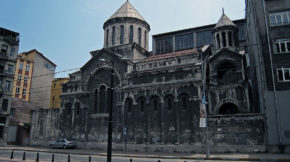
Surp Giragos was regarded as one of the largest and most important Armenian churches in the Middle East, with seven altars. Built between the 14th and 15th centuries, Surp Giragos (Saint Cyriacus in English) was rebuilt and restored in 2011 through a joint initiative of the pro‑Kurdish municipality, led by its mayor Osman Baydemir, and the then Vicar General of the Patriarchate of Istanbul, Archbishop Aram Ateşyan, with support from Turkish patrons and members of the Armenian community originally from Diyarbakir.
The reconsecration of Surp Giragos in November 2011 enabled many crypto‑Armenians to rediscover their identity, through the renewed presence of an Armenian landmark in the historic center of Sur. This was the former Armenian and Assyrian quarter, nicknamed “Gâvur Mahallesi” (“the neighborhood of infidels”) by Muslims in reference to its once predominantly Christian residents. The district is made up of narrow alleys and old houses built from basalt, the black volcanic stone characteristic of the city’s architecture.
In a place where no Armenians had lived since the late 1970s, a new Armenian community gradually formed around the church. Many Armenians from Islamized families were able to reconnect with their ancestral culture through activities organized there, such as Sunday lunches, Easter and Christmas celebrations, baptisms, and trips to Armenia; events that sometimes brought together more than a thousand people.
2015–2016 – Urban guerrilla warfare in Diyarbakir
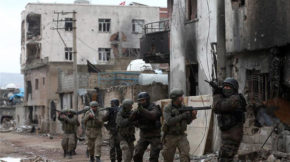
The Armenian community’s momentum came to a sudden halt in September 2015, as the neighborhood surrounding the Surp Giragos Church turned into a battlefield.
Following the cancellation of Turkey’s July 2015 parliamentary elections, Kurdish PKK forces, galvanized by their victories in Syrian Rojava, came down from the mountains to take control of the city centers of several cities in southeastern Turkey, including Diyarbakir.
A bloody urban guerrilla war unfolded in the historic district of Diyarbakir, a medina consisting of a labyrinth of narrow streets, around the Surp Giragos Church. After eight months of fighting, in April 2016, the defeat of Kurdish forces at the hands of the Turkish army was confirmed. Not long after, a large part of the Sur district was razed, nationalized, and closed to the public. The Armenian churches belonging to the Armenian Foundation (Surp Giragos and Surp Sarkis) and the churches (Catholic and Protestant) under the control of the Turkish state, although damaged by the fighting, were not destroyed.
Part of Sur’s population was evicted, expropriated, or compensated minimally. The neighborhood was handed over to developers for real estate speculation, distorting its historical heritage. Today, it features wide avenues where brand-new villas and stores stand alongside the ruins of what remains of the old city. A demographic engineering policy of gentrification was implemented by the Turkish authorities to replace the neighborhood’s former population—modest and pro-Kurdish—with a more affluent, AKP-aligned population.
Years of uncertainty
Initially, the Surp Giragos Church was nationalized, but in 2017 a Turkish court overturned this decision and returned the property to its legal owner, the Foundation.
In the meantime, Diyarbakir’s pro-Kurdish mayor, Gültan Kışanak, was arrested in October 2016.
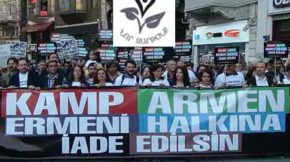
She was removed from office and replaced by a state-appointed administrator (Kayyım). It was under Gültan Kışanak’s mandate that YERKIR, in partnership with the municipality, organized a historic first in Western Armenia: a commemoration of the Armenian Genocide on April 24, 2014, in the form of an exhibition titled “99 Portraits of Exile – 99 Photos of Survivors of the Armenian Genocide”
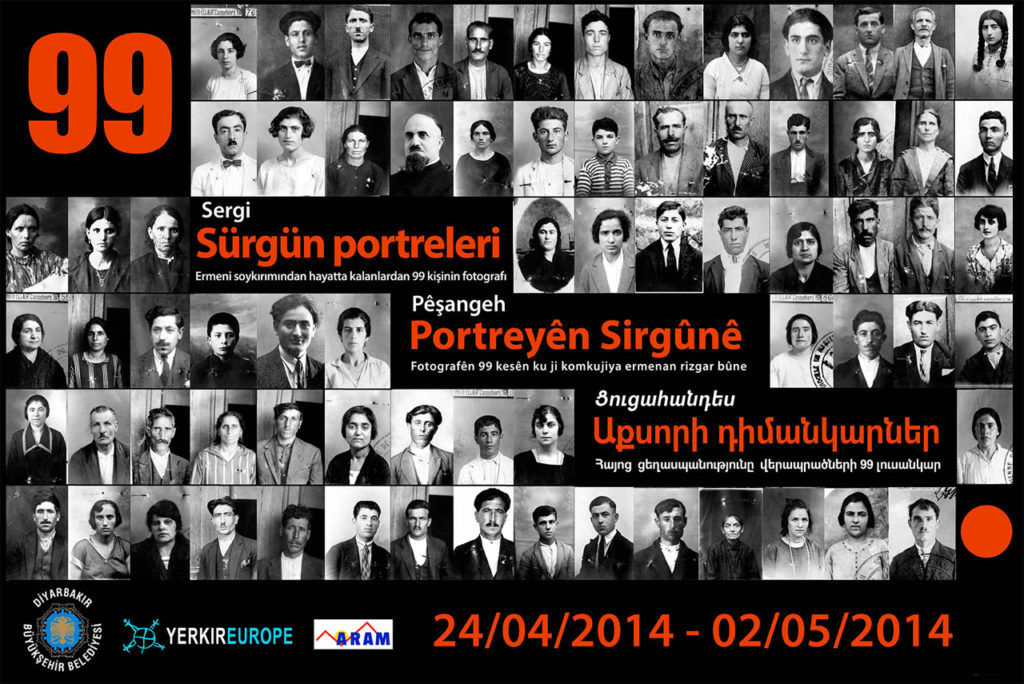
One week before Gültan Kışanak’s arrest, our NGO had negotiated with the municipality’s cultural department to include an annual Armenian program in the schedule of their new cultural center. This project was effectively abandoned when all the municipal departments with which YERKIR had worked for nearly a decade (the mayor’s office, international relations, culture, youth, conservatory, museum, exhibitions, etc.) were dismantled and replaced by pro‑AKP officials.
This situation persisted for eight years, until the last municipal elections in March 2024, when the pro-Kurdish DEM party (formerly the HADEP) regained control of Diyarbakir City Hall. These elections have not (yet) been contested.
The Turkish paradox
For eight years, from 2016 to 2023, the Surp Giragos Church remained within the exclusion zone. Inaccessible and off-limits, leaving the small, resurgent community without a place to gather.
Paradoxically, the Turkish state, through the Kayyıms in Diyarbakir, oversaw the renovation and restoration of Surp Giragos, with contractors selected by the church’s Foundation.
A grant of several hundred thousand euros financed the restoration work, as well as the construction of new adjacent buildings and an inner courtyard, completed in early 2023.
In the same neighborhood and over the same period, the Turkish government also funded the renovation of the Armenian Catholic and Armenian Protestant churches. Previously used as warehouses and a training center, these state‑owned buildings were restored but not reconsecrated. The former Armenian Catholic church now serves as an annex of Diyarbakir University’s library.
Restoration and reconsecration of a second church in Diyarbakir
Urban guerrilla warfare, the closure of Surp Giragos, and political pressures have left their mark. After years of uncertainty, the city’s nascent Armenian community is slowly recovering.
Today, following the renovation of the Sur neighborhood, the Surp Giragos Church has become one of the focal points of Diyarbakir’s burgeoning tourism industry, with nearly 1,200 daily visitors.
The Surp Giragos Church Foundation has also embarked on the renovation of another church under its helm, Surp Sarkis. Before it fell into ruin, at the mercy of stone thieves, the Foundation decided to restore a second site belonging to the Armenians in the old city of Diyarbakir.
The Surp Sarkis Church is a major architectural and cultural landmark of the Sur district’s historical heritage. It covers 700 sqm on a 4,000 sqm plot that will be surrounded by retail spaces, with the aim of financing the management of both churches. Guest rooms will be built in the architectural style of the church and the old city.
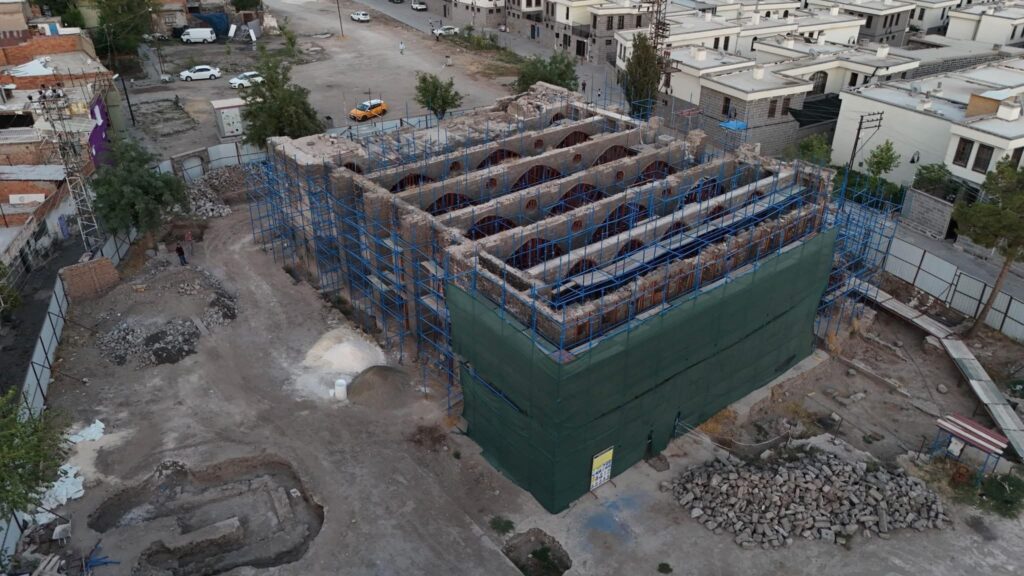
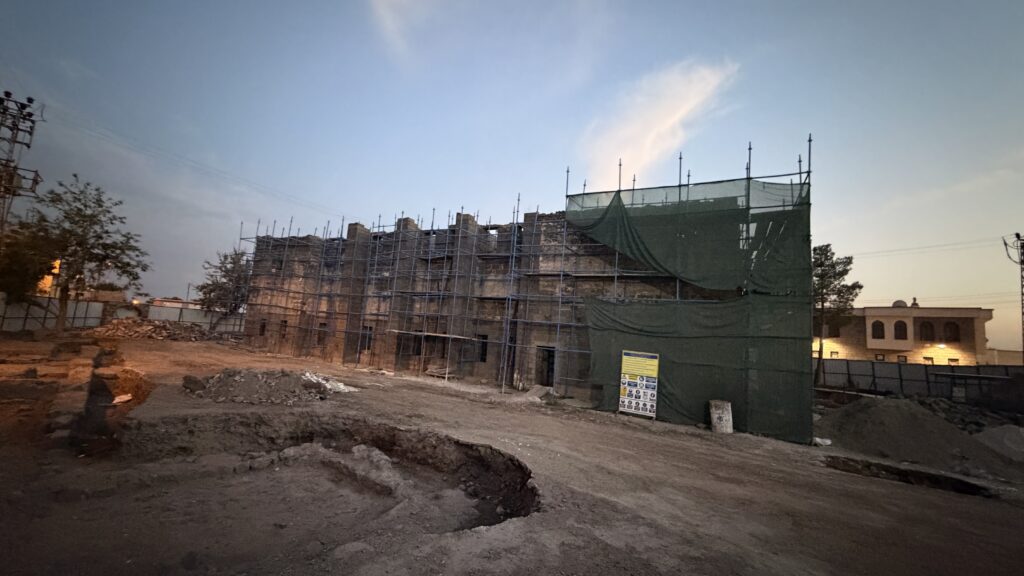
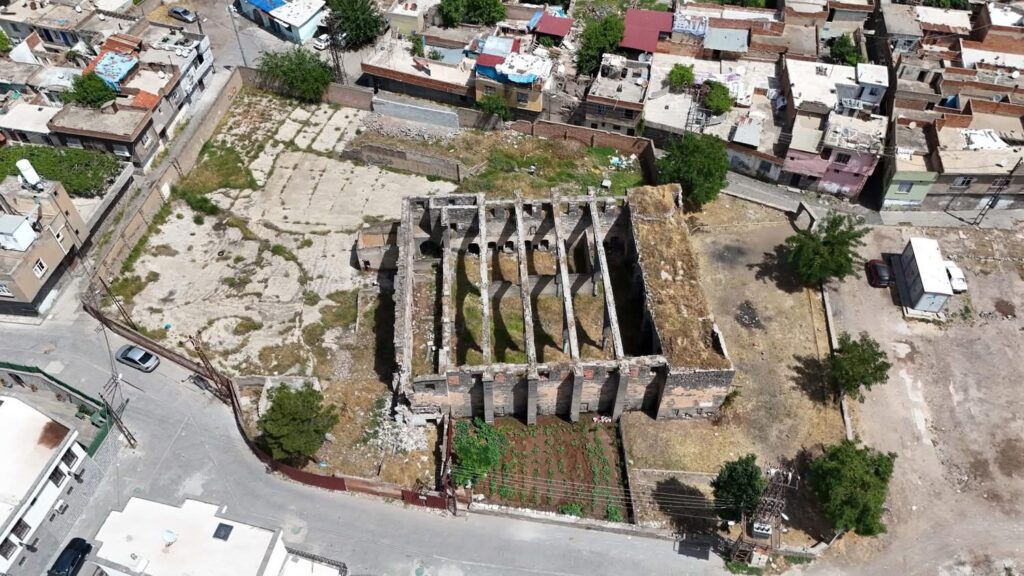
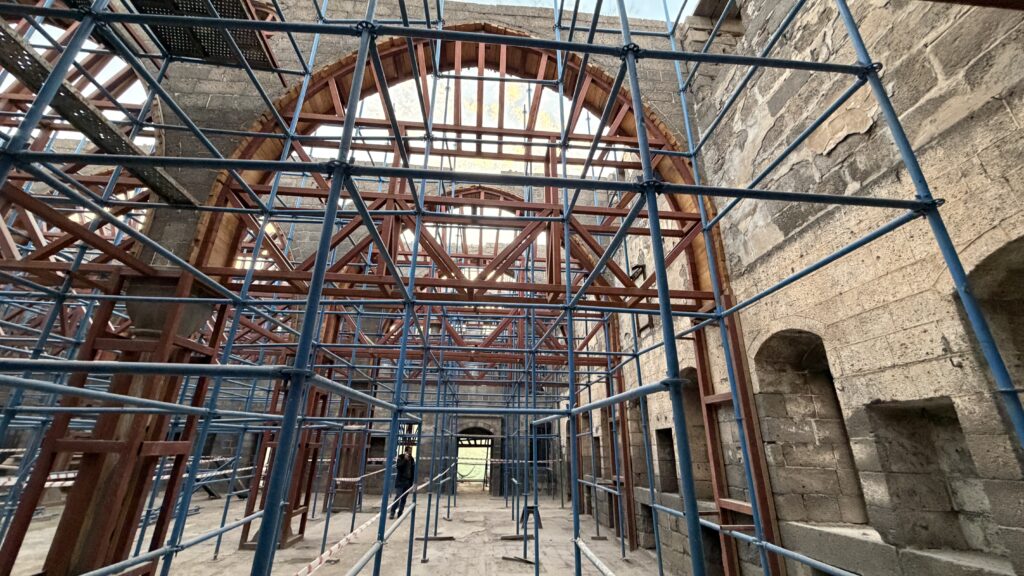
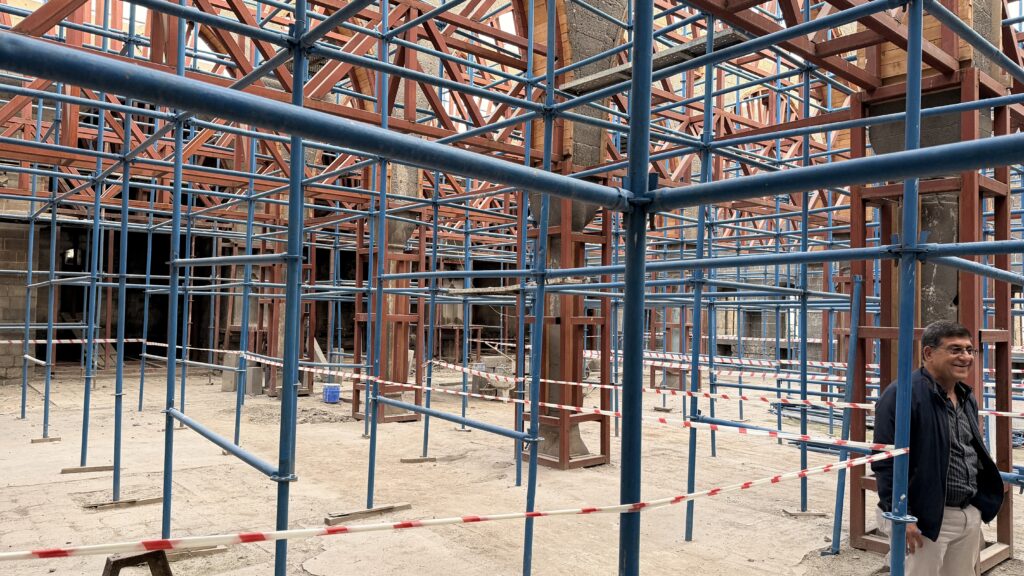
This is one of the very rare opportunities in decades for the reconstruction of Armenian churches that have belonged to a religious foundation in Turkey. This, in itself, is a small symbolic victory for this “new” Armenian community.
Integration of Armenians into Diyarbakır’s public and political sphere
On Tuesday, November 11, a memorandum of understanding to fund the restoration of Surp Sarkis was signed between Serra Bucak, the DEM (pro-Kurdish) co-mayor of the Diyarbakır Metropolitan Municipality, and Ergün Ayık, President of the Diyarbakır Surp Giragos Armenian Churches Foundation, along with its Vice President Ohannes Gaffur Ohanyan.
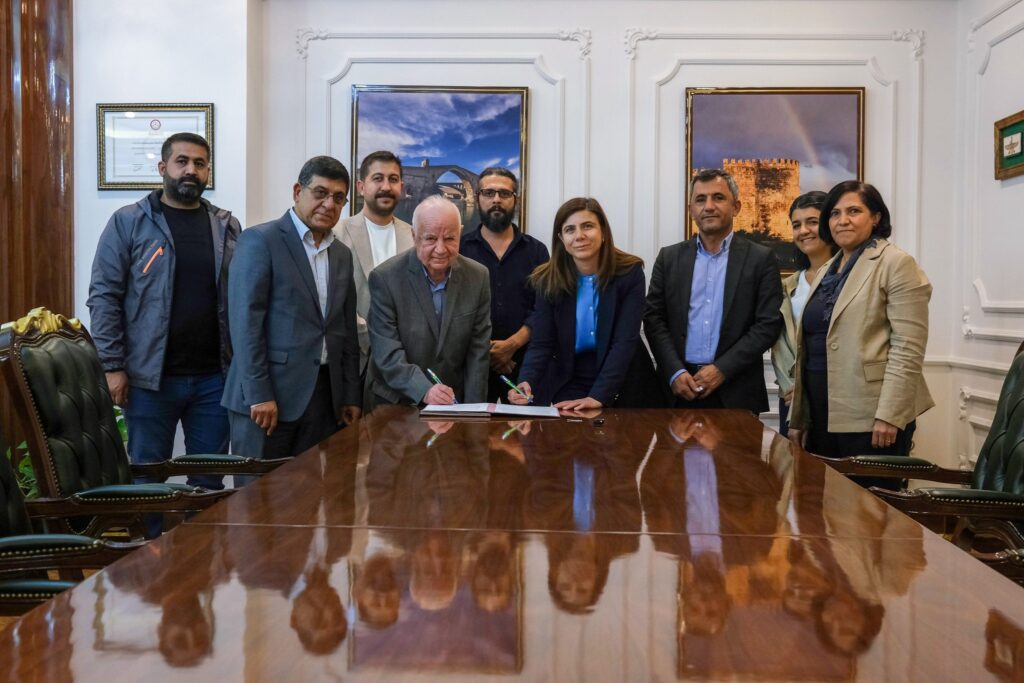
The municipality funds several Armenian cultural activities, such as weekly Armenian language classes conducted via videoconference with a teacher from Istanbul.
Armenians are now a recognized and integrated community in Diyarbakır’s public and political spheres, regarded as an integral part of the city. They participate in municipal activities as such, and a city council member of Armenian origin was even elected on the pro-Kurdish DEM majority list.
Re-Armenianizing
The Surp Giragos Church has served as a true magnet for fostering the formation of a new Armenian community in Diyarbakir. Today, it acts as an institutional bridge with public authorities, whether with state agencies (the prefecture) or the city’s (pro-Kurdish) administration.
But this structural success has its limits since, unfortunately, there is no real cultural or linguistic program to quench the thirst for Armenian identity among these “new” Armenians.
This audience comprises all age groups and various social categories. Their relationship to Armenian identity is above all an individual journey, the degree of awareness of which can vary from person to person.
There has been a slight increase in Turkish‑language works on Armenian history in recent years. However, these academic publications are poorly suited to the social reality of these communities. Although people often struggle to clearly articulate their expectations, there is an evident need to reconnect with local history and Armenian popular traditions.
Left to fend for themselves, these “new” Armenians have very high expectations of the diaspora to support them in their quest for Armenian identity.
Plans for Armenian cultural workshops in Diyarbakir
Contact between these “new” Armenians and the broader Armenian world remains extremely limited. Although Armenia’s geographic proximity allows for occasional encounters via tourism, these exchanges are rare. The Diaspora is often considered the custodian of the identity, culture, and language of Western Armenia but has, with very few exceptions, built almost no meaningful bridges with them.
Our NGO is working to support them in their search for identity. We are also striving to raise awareness of their situation by giving them a platform to share this reality, both within the Diaspora and in Armenia.
In early November, a delegation from YERKIR met with one of Diyarbakir’s co-mayors, Doğan Hatun, along with the directors of the cultural and international affairs departments and the leaders of the Surp Giragos Church. Together, we agreed to organize Armenian cultural workshops (for dance, song, and writing) in Diyarbakir this summer. Similar activities will also be offered in Van and Dersim, in collaboration with local associations and local Armenians.
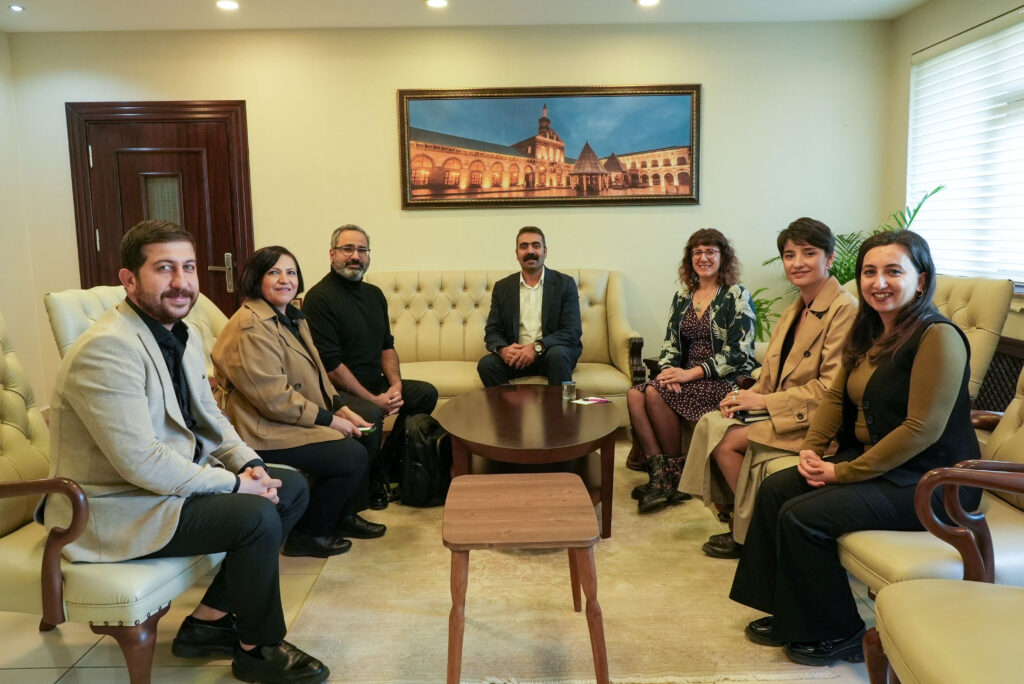
The aim is to support the local community by bringing Armenian intangible cultural heritage to them, while also sharing it with the wider population of Diyarbakir.
These initiatives will begin as pilot projects designed to establish permanent Armenian cultural activities in Diyarbakir. We then hope to replicate and scale them in other cities of historic Armenia where there is a strong desire to reconnect with Armenian identity, such as in Dersim, Kharpet, Mush, Hamshin, and beyond.
1- YERKIR NGO : Armenia – Karabakh – Javakhk – Turkey/Western Armenia.
Being an actor, not a spectator.
The French-Armenian NGO YERKIR has been active in the field since Armenia’s independence and the First Nagorno-Karabakh conflict.
We believe we must be actors, not spectators, which is why our projects have always been led locally by French citizens of Armenian origin. Over the years, this sustained presence has given us invaluable experience in identifying the room for maneuver needed to implement concrete projects that respond to new challenges facing the Armenian cause.
Such was the case in Artsakh and Armenia, where we undertook resettlement programs (such as rebuilding villages) and agro-economic development programs from 1990 to 2015 to secure the border regions of Karabakh, Tavush, and Gegharkunik.
In Georgia, we have worked to defend the civil rights of the Armenians of Javakhk and oppose the plundering and “Georgianization” of Armenian churches in Tbilisi.
In Azerbaijan, we have countered historical revisionism regarding the “Caucasian Albanians” settlement of Artsakh by initiating archaeological excavations and enabling the discovery of the ancient city of Tigranakert in Artsakh in August 2006.
The field experience of YERKIR in Turkey and Anatolia have taught us that Armenian issues are not merely part of this country’s history and memory, but that they remain very much alive in the sociocultural and socioeconomic challenges facing Turkish and Kurdish societies.
For Turkish civil society to engage with these questions, it is necessary to establish and develop projects focused on Armenian tangible and intangible cultural heritage, as well as on conflict resolution.
This is why our NGO has developed ethnographic and ethnomusicological research programs in Turkey through cultural projects and expert study groups aimed at rehabilitating Armenian cultural heritage. This includes the Van Project2 on cultural rights with the MiASiN!3 Group, the organization of an April 24 commemoration in 20144 in Diyarbakir in partnership with the metropolitan municipality, work on intercultural dialogue via the Armenian-Turkish digital platform REPAIR5 (140 articles, interviews, and online exhibitions fully translated into English, French, Armenian, and Turkish), as well as conflict-resolution initiatives through Track II diplomacy.
2- Van Project: Fragments of Armenian identity in Turkey
3- MiASiN ! The Intimate Melodies of Anatolia
4- A historical 24th April in Diyarbakir
5- REPAIR: Armeno-Turkish digital platform