
The defeat in the 2020 “44-day war,” followed by the loss of Artsakh in 2023, has brought into sharp focus the strategic miscalculations made by Armenians over the past three decades. Territorial losses, emigration, and demographic decline within Armenia, combined with ongoing assimilation across the diaspora, are steadily reducing the Armenian sphere of influence on multiple fronts.
Yet even in this difficult context, Armen Ghazarian of the French-Armenian NGO YERKIR1, there remains room to maneuver to regain a foothold in unexpected territories, including Turkey. Such an approach could help revive Armenian identity and communities on their historical lands, while also reopening engagement with the question of the genocide within Turkish society.
At first glance, the idea that Armenians might re-establish themselves in the very places marked by the violence of 1915 may seem improbable, given the immense challenges that lie ahead. But this perspective also holds the seeds of a redefinition of Armenian identity, of the relationship to Armenian “territories”, of a transnational structure, which the diaspora and Armenia need to reinvent by themselves.
A present wasted for a past that had no future
The title of this article, “Armenian genocide: What if the solutions lay in Turkey?”, might seem almost to answer itself. Yet the strategy adopted by the Armenian diaspora in pursuing recognition of the genocide has largely been to frame it as a memorial cause, used in a unilateral way within diaspora communities and their respective national contexts.
This positioning has enabled Armenians to secure a presence in the public and political spheres of their host countries, but it says little about what they might contribute in terms of concrete strategies or solutions with regard to Turkey itself.
The question of the genocide has thus been treated as an Armenian-American, Armenian-French, or Armenian-European issue. Yet it is, first and foremost, a Turkish one, and it must be addressed in Turkey by engaging Turks in their own language. To make peace or to wage war, it takes two. In this case, the “battlefield” of recognition, which lies in Turkey, has been deserted.
It is striking to see that no strategy has been put in place vis-à-vis Turkey and its civil society to disseminate, from the Armenian diaspora, publications in Turkish within Turkey on the genocide, as well as on Armenian history and culture. This is all the more surprising given that social media provide tools for mass dissemination, making it possible to circumvent the difficulties of acting on the ground.
– Memorial maintenance
At the same time, over these two decades, trapped within what can be called a form of “memorial maintenance,” no real alerts or warnings regarding a resumption of war in Karabakh, nor structural projects promoting the development and security of Armenia and Artsakh, have been effectively implemented.
Moreover, the issue of Karabakh, like that of the blockades imposed by Turkey and Azerbaijan, was never integrated into the international recognition of the genocide. This is despite the fact that the pan-Turkic political agenda, at the root of 1915, was present again from the very beginning of the conflict in 1988, and later materialized during the “44-day war” and the loss of Artsakh.
REALPOLITIK AND THE DIASPORA’S DISCONNECTION
The new challenges associated with Armenia’s independence in 1991 should have opened up new perspectives. Realpolitik, along with engagement on these new fronts of the Armenian cause through the involvement of diaspora actors, should have made it possible to anticipate the issues arising from the region’s political and geopolitical evolution.
– Compartmentalization of Armenia/Diaspora relations
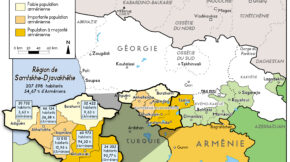
Other forms of engagement, beyond humanitarian or charitable efforts, should have been developed, notably by diversifying approaches to adapt to specific contexts and respond to the needs of Armenia, Artsakh, and Javakhk.
Unfortunately, relations between Armenia and the diaspora were compartmentalized by pan-Armenian structures, obscuring the country’s internal and external challenges during the administrations of Robert Kocharyan (1998-2008) and Serzh Sargsyan (2008-2018).
During this period of expanding globalization, the diaspora network, already adapted to and integrated into this system, should have evolved into a transnational soft power network capable of breaking Armenia’s isolation. Instead of making the memory of the genocide its sole focus, it should have simultaneously supported Armenia’s economic and security development, while making the resolution of the Nagorno-Karabakh conflict a top priority.
Turkey – the Armenian taboo
The issue of the Armenian Genocide emerged in the public sphere in Turkey when the AKP allowed certain long-standing taboos to be lifted in the early 2000s. At that time, the AKP and Erdoğan did not yet have full control over all branches of power, and the military still played a decisive role in state affairs.
The lifting of the Armenian taboo served several purposes: to appease Western governments, particularly the EU, and to shift responsibility for the genocide onto the pro-Western elites of the time, namely the “Young Turks” and the “Kemalist Republicans,” thereby exonerating the religious conservatives the AKP emerged from.
Hrant Dink and Pandora’s box
This opening unsurprisingly remained unofficial, as the AKP authorities have consistently denied the genocide. They nevertheless allowed Hrant Dink, an Armenian journalist in Turkey, to continue publishing his newspaper Agos, one of the pioneering platforms of this movement. Dink brought together a wide range of public intellectuals, journalists, academics, artists, and civil society figures in Turkey, including liberal circles that, at the time, were close to the AKP.
His assassination in January 2007, which was intended to silence him, paradoxically amplified the movement. Pandora’s box was now opened, the Armenian question was taken up by segments of the Turkish and Kurdish intelligentsia, who used it to advance broader agendas within Turkey, including democratization, EU accession, minority cultural and linguistic rights, and human rights.
The 2015 centennial of the Genocide
The 2015 centennial of the Armenian genocide served as a powerful tool of global communication, but it had no real impact on the Turkish state. Nor, for that matter, did recognition by the U.S. Congress in 2019 or by Joe Biden in 2021. Yet for decades, the diaspora had been led to believe that recognition by the United States would be the final nail in the coffin, forcing Turkey to acknowledge the genocide.
Now that the centennial has passed, this crime against humanity has been relegated to the status of an established historical fact, much like the genocide of Native Americans by the United States, which in practice has led to neither meaningful recognition nor reparations.
The spiral of repression in Turkey
Since the cancellation of the June 2015 parliamentary elections, Turkey has entered a cycle of repression affecting all strata of society. The situation no longer allows Armenian issues to be addressed as openly as they were between 2005 and 2015. Repression has dried up media platforms and partnerships with Turkish NGOs and opinion leaders who once enabled these topics to circulate within civil society.
Even though the Armenian question has been pushed to the bottom of Turkey’s list of concerns, there is still room to maneuver in the realms of culture and identity. Solutions therefore need to be conceived from within Turkey, despite the persistence of state-sponsored denialism and Ankara’s continued support for Azerbaijan.
ACTING IN TURKEY
Because it is essential to be an active participant in one’s own struggle, the establishment of the diaspora in Turkey takes on its full meaning. The goal is to amplify the voices of Armenians from these territories, descendants of genocide survivors. Unfortunately, few diaspora organizations have established themselves in Turkey with sustainable projects.
Building networks in Turkey
Carrying out activities in Turkey and in “historical” Armenia makes it possible to forge links and build networks with various circles – intellectual, media, cultural, diplomatic – and with Turkish civil society organizations. It also creates connections with populations who, by virtue of their histories and situations, feel close to Armenians, such as Kurds, Alevis, Zazas, Laz, as well as crypto-Armenian populations (Islamized, Alevi, Hemshin).
It turns out that, in Turkey, certain communities that lived alongside Armenians before 1915 have retained, and continue to preserve, memories and fragments of their cultural heritage.
Concrete projects in Turkey
The field experience of YERKIR in Turkey and Anatolia have taught us that Armenian issues are not merely part of this country’s history and memory, but that they remain very much alive in the sociocultural and socioeconomic challenges facing Turkish and Kurdish societies.
For Turkish civil society to engage with these questions, it is necessary to establish and develop projects focused on Armenian tangible and intangible cultural heritage, as well as on conflict resolution.
This is why our NGO has developed ethnographic and ethnomusicological research programs in Turkey through cultural projects and expert study groups aimed at rehabilitating Armenian cultural heritage. This includes the Van Project2 on cultural rights with the MiASiN!3 Group, the organization of an April 24 commemoration in 20144 in Diyarbakir in partnership with the metropolitan municipality, work on intercultural dialogue via the Armenian-Turkish digital platform REPAIR5 (140 articles, interviews, and online exhibitions fully translated into English, French, Armenian, and Turkish), as well as conflict-resolution initiatives through Track II diplomacy.
Resurgence of the Armenian identity
During the same period, a resurgence of Armenian identity emerged in Turkey among crypto-Armenians (Islamized, Alevi, Hemshin, etc.).
As virtually the only diaspora organization with long-term projects in Turkey, we have witnessed this awakening of identity among these “new Armenians” in Dersim, Diyarbakir, Mush, Van, Istanbul, Kharpet, and among the Hemshin, as well as the recent beginnings of their organization into associations in various cities of eastern Turkey in “historical” Armenia.
The Hemshin people
The Hemshin people (Համշենցիներ in Armenian, Hemşinliler in Turkish) are Armenians descended from the historic Armenian principality of Hemshin (8th-15th centuries), located between the Pontic mountain range and the Black Sea, which is now part of the Turkish province of Rize. The Hemshin also live in the Turkish province of Artvin, in the region surrounding the city of Hopa, near the Georgian border.
Some of the Hemshin were Islamized in the 18th century, and their Armenian dialect, Homchetsi (Հոմշեցի), is still spoken primarily in the province of Artvin in Turkey. Meanwhile, the Hemshin who remained Christian and went into exile at various times in Russia (primarily in Krasnodar and Abkhazia) still speak the Homchetsma (Հոմշեցմա) dialect, which is close to Homchetsi. A third group of Islamized Hemshin, mainly in the province of Rize in Turkey, speak Hemchinji, a Turkish dialect with numerous Armenian lexical borrowings.
Who are the Hemshin today?
There are two ways to answer the question “Who are the Hemshin?” The first is to look at how the Hemshin currently living in Turkey define themselves. The second is to examine the origins of this identity. From the first perspective, they are Armenians who, after converting to Islam, became an integral part of the Turkish and Muslim community, with a recent tendency among some to assert themselves as a distinct group that has developed its own identity from a transformed Armenian cultural and linguistic heritage.
The Hemshin do not form a homogeneous or structured group. There are no reliable statistics on their number in Turkey, and estimates range from several hundred thousand to two million. Many Hemshin are implicitly aware of their link to the Armenians: some accept it, while others reject it outright. Most have migrated to Turkey’s major urban centers, where they have undergone acculturation and assimilation. It is within this majority that one most often finds a tendency to deny or repudiate the Armenian origins of the Hemshin.
CRYPTO-ARMENIANS
The issue of crypto-Armenians – Islamized, Alevized, Kurdified, or Turkified – emerged with the lifting of the Armenian taboo in Turkey.
The Remnants of the Sword
After the 1915 genocide, survivors found refuge in what is now the diaspora and in the Soviet Republic of Armenia. The fate of those who remained in territories that had been predominantly Armenian before 1915 was long ignored. Some of these survivors owed their lives solely to the “self-interested” protection of certain Kurdish tribes. Women and young girls were most often abducted and forced into marriage, while orphans were taken in by Turkish or Kurdish families in the regions ravaged by the massacres. For decades, these “remnants of the sword,” as they are called in Turkish, managed to survive but were gradually assimilated over successive generations, whether out of a need to remain hidden or through the slow effects of acculturation.
Diyarbakir/Tigranakert
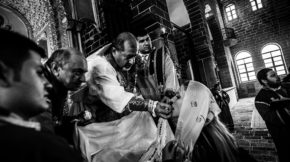
The reconsecration of Surp Giragos in November 2011 enabled many of these cryptoArmenians to rediscover their identity, through the renewed presence of an Armenian landmark in the historic center of Sur. This was the former Armenian and Assyrian quarter, nicknamed “Gâvur Mahallesi” (“the neighborhood of infidels”) by Muslims in reference to its once predominantly Christian residents. Where there had been no Armenians since the late 1970s, a new Armenian community has formed around this church. Many Armenians from Islamized families have thus been able to reconnect with their original culture through activities organized around the church, such as Sunday lunches, Easter, Christmas, baptisms, and trips to Armenia.6
Endogamy
In Dersim, populated mainly by Alevis, “Alevized” Armenians have found their voice again by creating several associations of Armenians from Dersim in Tunceli. In Mush, the “Daron Mush Association for Armenian Solidarity” was established in 2014 and even has its own premises. The crypto-Armenians of the Mush plain, as well as some in Diyarbakir and other regions of Western Armenia, have developed endogamous practices through marriages between Islamized Armenians.
These are the most advanced examples of a desire to return to Armenian roots. They serve as a model for thousands of other Armenians in these regions who cannot openly affirm their identity.
How to meet their identity-related needs
Unfortunately, these crypto-Armenians are left to their own devices and have no means of fulfilling their identity, cultural, and linguistic aspirations. Speaking only Turkish and Kurdish, they have no access to resources that would allow them to learn their ancestral language, history, and traditions.
In recent years, these communities have felt abandoned by the Armenian diaspora. To what extent can their expectations be met, given the significant language barrier to communication? In examining this question, we realized that traditional Armenian institutions in Istanbul (schools, foundations, churches), which possess Armenian educational materials in Turkish, do not wish to get involved, rightly or wrongly.
The example of the Surp Giragos Church in Diyarbakir speaks volumes: in 15 years of existence, no priest has been permanently assigned by the Patriarchate of the Armenian Apostolic Church of Istanbul, even though such a priest could respond to needs for religious, cultural, and linguistic education, as well as help structure and sustain this new Armenian community.
DIVERSE SOCIOLOGY
These populations who are questioning their Armenian identity are found mainly around major urban centers where Armenian associations have developed, such as Mush, Diyarbakir, Dersim, and Istanbul.
This public encompasses all age groups and a wide range of social backgrounds. Their relationship to Armenian identity is above all an individual process, and the degree of identity awareness varies from person to person. Their quests for knowledge and their questions have so far gone largely unanswered. In recent years, publications in Turkish on Armenian history and culture have appeared, but these largely academic works have proven ill-suited to the sociological realities of these communities.
Experiments in Armenian language learning
Various attempts to teach the Armenian language have been made in Diyarbakir, Mush, and Dersim, all of which ended in failure. When we were preparing a series of training courses in Mush and Diyarbakir, it became clear that conventional school-style courses in Turkish on Armenian culture and history would not be appropriate for such heterogeneous audiences.
Although they struggle to articulate their expectations, it is clear that there is a strong need to situate themselves within a local history rooted in Armenian traditions, ways of life, and popular culture.
Can one be both Muslim and Armenian?
This is a recurring question raised during our various meetings. Crypto-Armenians come from diverse historical and sociocultural backgrounds: some are from Sunni environments, others have lived in Alevi contexts. Some grew up within Kurdish culture, others within Turkish culture. Some descend from families that converted during the 1915 genocide, while others, like the Hemshin, trace their conversion back to the 18th century.
While Armenians around the world have institutional structures that provide them with both practical and symbolic means to act and think of themselves as Armenians, these crypto-Armenians have only their past, the history of their families, as the basis on which to ground their Armenian identity.
Is the Christian religion intrinsic to Armenian identity?
Yet Armenians existed long before they became Christians. The Armenian/Christian reference remains an important marker, although in the traditional diaspora the relationship to faith and religious practice has become largely marginal and symbolic in affirming one’s identity. The spread of atheism and non-religious practice in the diaspora does not in any way prevent the recognition of Armenian identity. Why should it be any different for crypto-Armenians who are Muslim or Alevi?
Moreover, the Republic of Armenia itself operates with a different framework, since ethnic and religious minorities are recognized as integral parts of Armenia’s national community.
REDEFINING ARMENIAN IDENTITY
The traditional diaspora, already subject to intense assimilation, has, through its structures, confined itself to an identity marker primarily centered on the memory of the genocide.
Erosion of the community fabric
Twenty-five years of this approach have led to saturation, demobilization, and a drying up of the community fabric. The younger generations, particularly affected by this state of affairs, have become aware of the gap between rapidly changing realities on the ground (in Armenia, Turkey, the Caucasus, the Middle East, etc.) and a policy frozen around genocide memory.
This has distanced entire segments of these younger generations, who no longer want to, and no longer can, bear the burden of a purely negative memory. How can we claim to look toward the future while highlighting only the suffering of the past?
To make matters worse, the younger generations who now look back on the period from Armenia’s independence to the defeat of November 9, 2020 inevitably ask: how could Armenia and the diaspora lose Artsakh when they did hold the upper hand for 26 years on the military and territorial levels to resolve the Nagorno-Karabakh conflict in their favor?
The Diaspora: how many divisions?
Since Armenia’s independence, Armenian identity in the diaspora has neither been rethought nor redefined in light of the many new issues and challenges that have emerged. Estimates of the number of Armenians in the diaspora range from 8 to 10 million, although no statistical study or census clearly supports these figures.
Beyond the numbers, there is significant heterogeneity in how the very concept of identity is understood in the diaspora. It is striking that the category “Armenian of the diaspora” tends to define an origin (descent from genocide survivors) more than it describes a national identity.
Identity: the Diaspora and crypto-Armenians, same struggle
The majority of Armenians in the diaspora, at least those living in the West, are assimilated or acculturated, yet they may at times experience moments of identity revival. Without clear reference points or direction, without defined rights or duties, without political or societal projects, identity in the diaspora becomes protean, an à la carte identity in which each person forges their own definition according to their desires or the mood of the moment.
Just as estimates of the millions of Armenians in the diaspora are approximate, some speak of hundreds of thousands, even millions, of crypto-Armenians in Turkey, again without solid scientific data. Whether in the diaspora or in Turkey, one must recognize the substantial difference between simply being of Armenian origin while remaining detached from it, and actively affirming one’s Armenian identity.
Non-existent debates
Are the processes of acculturation and assimilation in the Armenian diaspora really so different from those experienced by crypto-Armenians in Turkey? The question of the identity of these crypto-Armenians ultimately raises a problem that is quite similar to that of the diaspora itself. How can we respond to their concerns when this debate does not even exist within the diaspora?
The emergence of this phenomenon in Turkey should have sparked debates, not only to define an approach toward these communities, but also to consider the possibility for the diaspora to regain a foothold in these territories, left fallow since 1915, through the involvement of these new Armenians.
BREAKING OUT OF THE RUT
To break out of this rut, we need to recreate spaces for reflection that can foster new political and societal projects and help build concrete, meaningful links between a renewed transnational Armenian identity and Armenian territories.
In this regard, Armenia, the diaspora, Turkey, and the role of these new Armenians all make it necessary to redefine comprehensive strategies for cultural, social, and political action.
In Turkey, specific projects must therefore be designed and adapted to the constraints of existing tensions, while creating new spaces for expression that allow engagement in fields as varied as human and cultural rights, languages, land registry and property, sustainable development, the arts and music, sports, cuisine, and tourism.
“RE-ARMENIZING”
There is very little contact between these new Armenians and the Armenian world. Proximity to Armenia allows for rare exchanges through tourism, but the diaspora, which is the custodian of this identity, this culture, and the language of Western Armenia, has, with very few exceptions, built virtually no bridges with them.
These new Armenians represent an invaluable opportunity to revive Armenian identity in Western Armenia. They can serve as a powerful channel of exchange between the diaspora and Turkish and Kurdish societies. They help break down stereotypes in the Turkish public sphere, promote Armenian culture, and bring to light Armenian historical realities and memories, including, indirectly, the 1915 genocide.
Armenians in the diaspora must recognize that they have a role to play in Turkey. They must mobilize to reach out to these new Armenians and support them in their quest for Armenian identity. If the diaspora does not become a stakeholder in this Armenian identity revival in Anatolia, then the Turkish state, once it becomes aware of the phenomenon, will move in to organize these communities and use them for its own purposes
PROJECTS FOR ARMENIAN CULTURAL WORKSHOPS IN DIYARBAKIR AND DERSIM
Our NGO, YERKIR, is working to support them in their search for identity. We are also striving to raise awareness of their situation by giving them a platform to share this reality, both within the Diaspora and in Armenia.
In early November, a delegation from YERKIR met with one of Diyarbakir’s co-mayors, Doğan Hatun, along with th leaders of the Armenian community in Diyarbakir. Together, we agreed to organize Armenian cultural workshops (for dance, song, and writing) in Diyarbakir which we will also conduct in Dersim.
The aim is to support the local community by bringing Armenian intangible cultural heritage to them, while also sharing it with the wider population of Diyarbakir.
These initiatives will begin as pilot projects designed to establish permanent Armenian cultural activities in Diyarbakir and Dersim. We then hope to replicate and scale them in other cities of historic Armenia where there is a strong desire: Van, Mush, Kharpet, Hamshen…
Armen Ghazarian
YERKIR NGO
1- YERKIR NGO – Armenia-Karabakh-Javakhk
Being an actor, not a spectator.
The French-Armenian NGO YERKIR has been active in the field since Armenia’s independence and the First Nagorno-Karabakh conflict.
We believe we must be actors, not spectators, which is why our projects have always been led locally by French citizens of Armenian origin. Over the years, this sustained presence has given us invaluable experience in identifying the room for maneuver needed to implement concrete projects that respond to new challenges facing the Armenian cause.
Such was the case in Artsakh and Armenia, where we undertook resettlement programs (such as rebuilding villages) and agro-economic development programs from 1990 to 2015 to secure the border regions of Karabakh, Tavush, and Gegharkunik.
In Georgia, we have worked to defend the civil rights of the Armenians of Javakhk and oppose the plundering and “Georgianization” of Armenian churches in Tbilisi.
In Azerbaijan, we have countered historical revisionism regarding the “Caucasian Albanians” settlement of Artsakh by initiating archaeological excavations and enabling the discovery of the ancient city of Tigranakert in Artsakh in August 2006.
2- Van Project: Fragments of Armenian identity in Turkey
3- MiASiN ! The Intimate Melodies of Anatolia
4- A historical 24th April in Diyarbakir
5- REPAIR: Armeno-Turkish digital platform
6- Diyarbakir’s Armenian community rises from the ashes of genocide